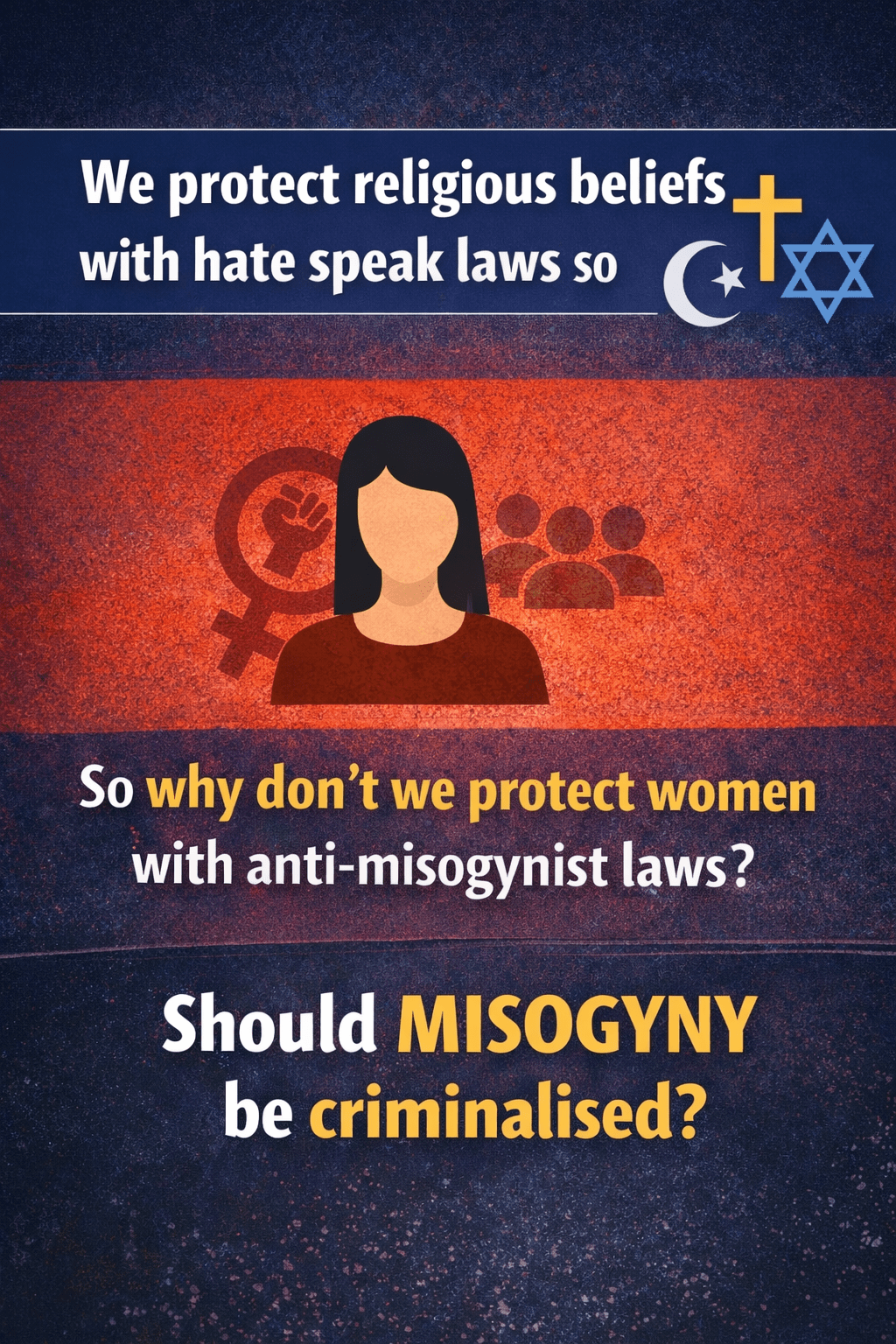
Modern democratic societies already recognise an important principle: some forms of discrimination and hate are so harmful that they require legal boundaries, not just social disapproval. That is why racism, religious hatred, antisemitism, and other group-based vilification are regulated under civil and criminal law. Yet one category remains conspicuously absent from that framework — misogyny.
Misogyny is not merely an opinion about women. It is a system of hostility, contempt, and dehumanisation directed at women as a class. It manifests in harassment, threats, incitement to violence, coercive control, and sustained abuse. In its most extreme forms, it escalates into physical violence and murder. Despite this, misogyny is still largely treated as a social issue rather than a legal one.
This gap matters.
We Already Criminalise Discrimination — Just Not Against Women
Most legal systems accept that speech and conduct targeting a protected group can cross a threshold where it causes serious harm to individuals and society. That is why laws exist to address racial vilification, religious hatred, and other protected characteristics. These laws are not about suppressing free speech; they are about preventing real-world harm that predictably follows dehumanisation.
Women, however, are routinely excluded from these protections.
A person can face legal consequences for publicly inciting hatred or violence against a racial or religious group, but similar conduct directed at women is often dismissed as “offensive,” “provocative,” or “part of the internet.” The implication is that harm against women is somehow less serious, less collective, or less deserving of protection.
It is none of those things.
Misogyny Is a Known Precursor to Violence
One of the strongest arguments for criminalising misogyny is evidence-based: misogynistic ideology is a well-documented pathway to violence.
Hostile attitudes toward women underpin domestic violence, sexual violence, coercive control, stalking, and online harassment campaigns. In many cases, perpetrators escalate from verbal degradation to physical harm. Law enforcement and academic research have repeatedly identified misogyny as a risk factor — not an incidental attitude, but a driving force.
We already recognise this pattern in other contexts. Racist ideology is treated seriously because it predicts harm. Extremist ideology is monitored because it escalates. Misogyny follows the same trajectory, yet remains legally invisible.
That inconsistency is not neutral. It has consequences.
Equality Before the Law Cannot Be Selective
If the law protects people from discrimination based on race, religion, sexuality, or disability, but excludes sex, then equality before the law is incomplete.
Women are not a niche group. They are not a minority defined by belief or behaviour. They are half the population. When hatred toward women is normalised, minimised, or left unregulated, it reinforces the idea that women should simply tolerate abuse as a condition of public life.
Criminalising misogyny would not mean policing disagreement or silencing criticism of ideas associated with feminism, gender roles, or policy. Laws already distinguish between lawful opinion and unlawful vilification. The same standards can apply here.
The question is not whether the law can handle misogyny. It already handles analogous forms of harm every day.
The real question is why women have been excluded.
Legal Recognition Changes Cultural Standards
Law is not only punitive; it is symbolic. What the law names as unacceptable shapes cultural norms, institutional responses, and public accountability.
When domestic violence was reframed as a crime rather than a private matter, reporting increased and social tolerance declined. When racial vilification laws were introduced, public discourse shifted. Criminalising misogyny would send a clear message: hostility toward women is not just rude or controversial — it is harmful, and it has limits.
Importantly, such laws would target conduct, not identity. They would focus on behaviour that incites harm, dehumanises, or threatens women as a group, consistent with existing hate-speech frameworks.
This Is Not About Special Treatment — It Is About Equal Protection
Opponents often argue that criminalising misogyny would create “special rights” for women. In reality, it would do the opposite. It would extend the same legal logic already applied to other protected groups.
Equality does not mean pretending harm is evenly distributed. It means responding proportionately where harm is systemic, predictable, and entrenched.
Misogyny meets that standard.
Until the law acknowledges misogyny as a serious form of discrimination — not merely bad behaviour — women will continue to be uniquely exposed to hostility with fewer protections and fewer consequences for perpetrators.
If we truly believe in equality before the law, then the exclusion of misogyny is not an oversight. It is a failure — and one that is long overdue for correction.
 Infemism
Leave a comment