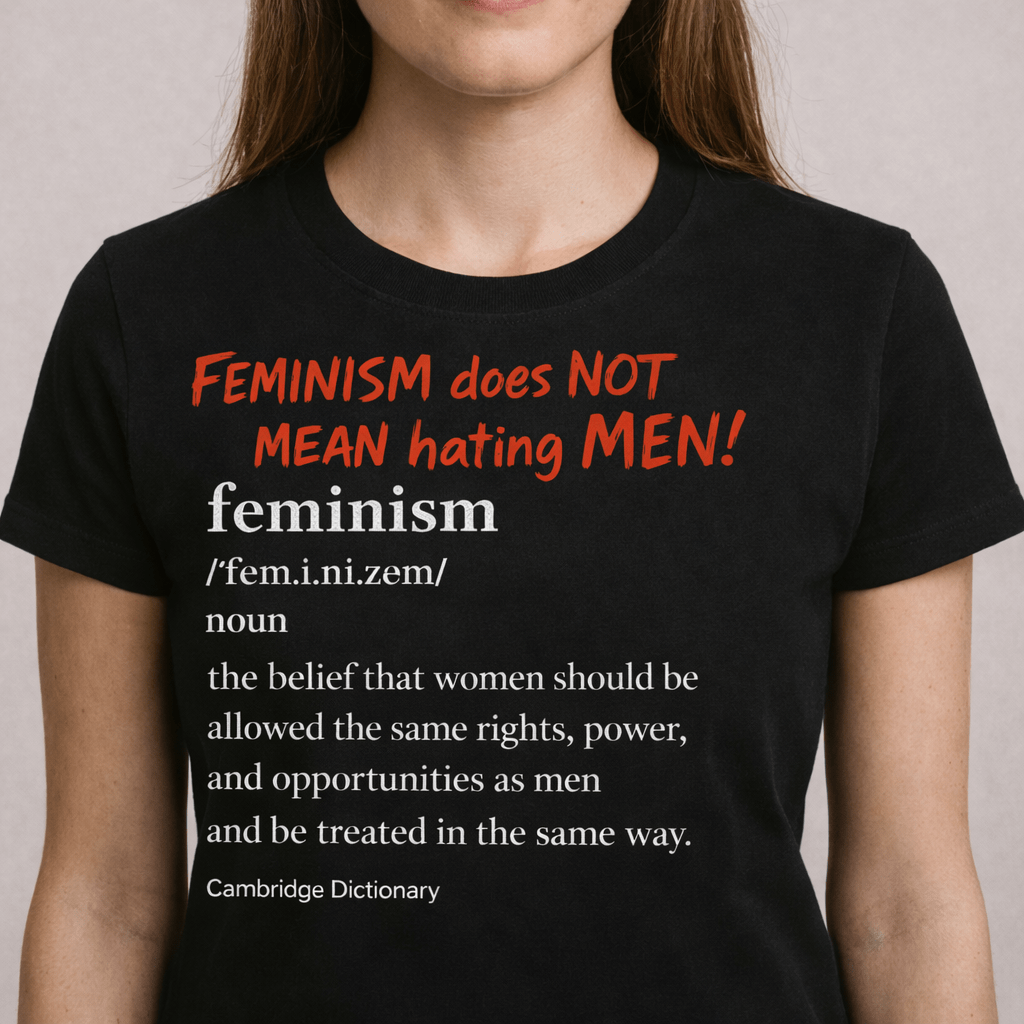
Sometimes the most effective form of control is to take a positive word — a word rooted in justice, equality, and empowerment — and twist it until it sounds like something shameful.
Few words have been more aggressively hijacked than feminism.
Feminism simply means the belief that women deserve equal rights and equal opportunities.
Nothing more.
Nothing controversial.
Both men and women can be feminists — it simply means the individual believes women and men should have equal rights.
But over decades, the word has been deliberately reshaped into something threatening, extreme, or unfeminine. Instead of symbolising equality, it has been repackaged as:
- man-hating,
- angry,
- unreasonable,
- radical,
- humourless,
- or socially disruptive.
This shift didn’t happen by accident. It happened because a powerful movement loses power if people are afraid to be associated with it.
When you make “feminist” sound like an insult, fewer women want to claim it.
When fewer women claim it, the movement becomes easier to dismiss.
And when the movement is dismissed, the status quo remains untouched.
The strategy is simple:
If you cannot stop women from demanding equality, you can try to make them embarrassed to stand under the word that represents it.
It is language as sabotage — soft, subtle, and socially accepted.
But the truth is unchanged:
Feminism has never been a threat.
Feminism is the reason women vote, work, own property, divorce abusive partners, access contraception, receive education, and have legal protections.
Feminism is safety.
Feminism is opportunity.
Feminism is equality.
And that is precisely why some people work so hard to turn the word into something ugly.
Reclaiming “feminism” is not just about correcting a misunderstanding —
it’s about refusing to let a movement for equality be weaponised against the women it protects.
Spinster — From Skilled Worker to Social Failure
The evolution of the word spinster tells a clear story about how women’s social value was historically tied to marriage.
Originally, in the Middle Ages, “spinster” referred to a woman who spun thread for a living.
It was a skilled and respected occupation — and the reason the term appeared on legal documents was because many women in that trade remained unmarried and financially independent.
By the 1600s, as marriage became increasingly viewed as a woman’s primary role, the word shifted dramatically.
“Spinster” no longer meant a craftswoman — it meant a woman who hadn’t married “in time.”
It became associated with:
- unattractiveness
- undesirability
- social failure
- being “left behind”
Meanwhile, the male equivalent — bachelor — took on a completely different meaning: free, independent, and even prestigious.
This divergence tells a historical truth:
Men were defined by their independence.
Women were defined by their marriageability.
The negative meaning of “spinster” was never about the women themselves — it was about enforcing the idea that a woman’s highest purpose was to wed.
Witch — The Demonisation of Wise and Independent Women
Few words have undergone a more dramatic transformation than witch.
In Old English, wicce simply meant a woman knowledgeable in healing, herbs, and spiritual practices.
These women were midwives, herbalists, birth attendants, and community healers — respected and relied upon.
But by the late Middle Ages, the rise of strict religious institutions and centralised authorities brought suspicion toward women with influence outside male control.
Between the 1400s and 1700s, a series of political, religious, and social forces turned “witch” into a dangerous accusation.
The word justified the persecution of women who were:
- widowed or unmarried
- property owners
- healers
- spiritually knowledgeable
- independent from men
- outspoken or unconventional
Tens of thousands were executed across Europe and colonial America.
The label “witch” became a powerful tool to eliminate women who did not obey, conform, or remain silent.
Even today, the word retains those historical associations — often used to describe older women, assertive women, or women who defy social expectations.
The evolution of “witch” tells a story of how societies have feared — and punished — women who hold knowledge and autonomy.
What These Histories Reveal
The stories of feminist, spinster, and witch each highlight a pattern:
Women who pursued independence, knowledge, or equality were often redefined in ways meant to diminish them.
- The feminist sought rights — and was reframed as unreasonable.
- The craftswoman who lived independently became a symbol of failure.
- The healer and wise woman was recast as a danger to society.
These are not stories about vocabulary.
They are stories about women’s lives — the freedoms they gained, the freedoms they were denied, and the cultural forces that shaped their identities.
Understanding the history behind these words allows us to reclaim their original meanings and recognise the strength, wisdom, and resilience of the women who carried them.
Because the true history shows this clearly:
The problem was never the women.
The problem is the world that fears them.
 Infemism
Leave a comment