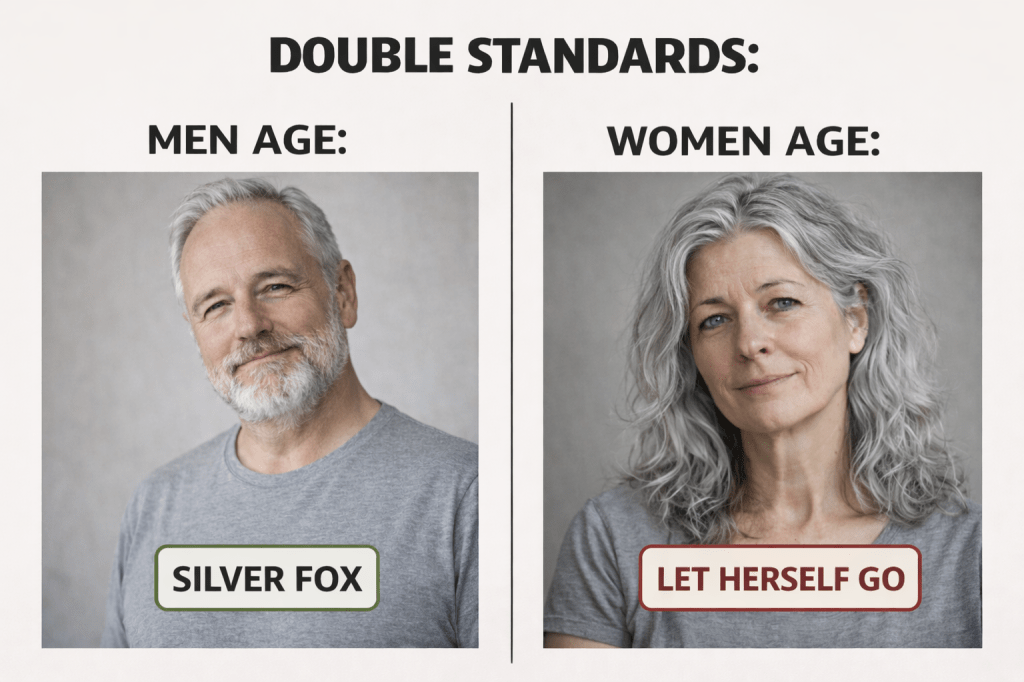
When it comes to age differences in relationships, the double standard is unmistakable — and deeply revealing.
Men and women can engage in the exact same behaviour, yet only women are handed degrading labels, while men receive social approval or, at worst, mild curiosity.
Language doesn’t just describe relationships.
It polices them.
How Women Are Shamed for Age
When a woman dates someone younger, the vocabulary becomes instantly insulting:
“Cougar” — implying predatory behaviour, as though a woman’s sexuality becomes dangerous once she passes 40.
The Term reduces the women to a caricatures: ageing bodies, inappropriate desires, jokes.
They send a clear message:
Women should not desire, attract, or choose partners outside the narrow boundaries society sets for them.
Meanwhile…
How Men Are Not Held to the Same Standard
When an older man dates a younger woman, he is rarely insulted.
Instead, he becomes:
- “distinguished,”
- “successful,”
- “a catch,”
- “proof he’s still got it,”
- or simply “dating someone younger,” with no moral weight attached.
Even the slang is flattering:
- “Silver fox.”
Not an insult — a compliment.
The behaviour is identical.
The judgement is not.
Young Women Are Judged Too — But Only Through a Lens That Protects Men
When a young woman dates an older man, she is assigned a different insult:
- “Gold digger.”
Again, the blame lands squarely on the woman.
No equivalent term exists for a young man dating an older, wealthy woman.
There is no universally used, culturally embedded insult aimed at men in that situation.
The language is strategically one-sided:
- Shame the woman for her motives.
- Protect the man from scrutiny.
Why This Double Standard Exists
These patterns aren’t random — they are built on patriarchal norms that dictate:
- Men are allowed to age without losing desirability.
- Women are expected to remain eternally youthful or become invisible.
- Men are praised for “pulling” younger partners.
- Women are mocked for the same thing.
- Men’s sexuality is viewed as natural at any age.
- Women’s sexuality is seen as inappropriate once they pass an invisible threshold.
The cultural script is clear:
Women’s desirability decreases with age, men’s does not and language is used to reenforce this.
How Patriarchy Conditions Women to Repeat These Insults
It’s not just men who use these terms.
Women repeat them too — often without realising that they are reinforcing a system designed to diminish them.
Society teaches women from a young age that:
- their worth is tied to youth,
- ageing is a personal failing,
- and desirability has an expiration date.
So women sometimes police each other:
- mocking older women who refuse to “act their age,”
- criticising women who date younger men,
- gossiping about women who step outside the expected script.
Patriarchy trains women to protect the very rules that harm them.
“Mutton Dressed as Lamb” — Policing How Women Are Allowed to Age
“Mutton dressed as lamb” is more than an insult.
It is a cultural warning label placed on older women who dare to dress in a way society has decided is reserved for the young.
The message is unmistakable:
Your attractiveness had an expiry date — and you’ve passed it.
Women are told that:
- youth equals beauty,
- beauty equals value,
- and value diminishes with age.
So if an older woman wears something stylish, bold, fitted, or revealing, she is mocked for “trying too hard” or “not acting her age.”
Her clothing becomes a statement people feel entitled to police.
How Men Are Allowed to Age Without Shame
When men age, their appearance is rarely used against them. In fact, they are often elevated by it.
An older man with grey hair?
- “Silver fox.”
- “Distinguished.”
- “A man who ages well.”
A man wearing clothes that are youthful or trendy?
- “Cool for his age.”
- “Stylish.”
- “Still got it.”
Unlike women, men are not told their desirability has an expiration date.
They are not punished for dressing confidently, expressing sexuality, or embracing youthfulness.
Language That Degrades Women vs. Language That Praises Men
Notice the pattern in the words we use:
For women:
- “Mutton dressed as lamb”
- “Cougar”
- “Desperate”
- “Trying to look young”
- “Age-appropriate”
All terms meant to criticise, mock, or humiliate.
For men:
- “Silver fox”
- “Distinguished”
- “Aged like fine wine”
- “Still handsome”
- “Young at heart”
All terms that praise, elevate, or validate.
Women age into ridicule.
Men age into respect.
Fashion Rules Are Gendered Too
Women grow up hearing:
- “Cover up — you’re too old for that.”
- “Don’t dress like you’re trying to be 20.”
- “Be modest.”
- “Be appropriate.”
Men grow up hearing:
- “Dress sharp.”
- “Wear what makes you feel good.”
- “Men look better with age.”
- “Confidence is attractive at any age.”
Even clothing becomes a mechanism of control:
- Women are shamed for showing their bodies.
- Men are praised for showing confidence.
When a woman’s appearance is constantly scrutinised, judged, and commented on, she learns that visibility itself is a risk.
The Age-Gap Double Standard Is Normalised on Our Screens
If anyone doubts that this double standard exists, they only need to look at who we see on television and in film — and how rarely it is questioned.
Older men paired with significantly younger women is not just common.
It is the default.
In news, entertainment, drama, and film, male presenters, actors, and protagonists routinely age on screen while their female counterparts are quietly replaced with younger, more conventionally attractive women.
This isn’t accidental.
It’s cultural training.
Television: The Presenter Pattern
Look at long-running TV shows, news panels, talk shows, and current affairs programs.
Male presenters are allowed to:
- grey,
- wrinkle,
- age visibly,
- stay employed for decades.
Their female co-hosts, however, are frequently:
- replaced,
- rotated out,
- or quietly disappeared once they age past a narrow “acceptable” window.
When an older male presenter appears next to a younger female co-host, it is framed as:
- professional,
- normal,
- aspirational.
No one asks:
Why is he still there?
Why is she half his age?
Why does authority age differently depending on gender?
Because the pairing itself has been normalised.
Film & Television: The Romantic Age Gap That Only Goes One Way
Hollywood has spent decades teaching audiences that:
- Men age into desirability.
- Women age out of it.
It is entirely unremarkable to see:
- a man in his 50s or 60s cast opposite a woman in her 20s or 30s,
- with the relationship framed as romantic, passionate, or aspirational.
When this happens, the male character is:
- powerful,
- successful,
- worldly,
- sexually validated by youth.
The woman’s youth is treated as a reward for his status.
Yet reverse the genders — even slightly — and the reaction changes instantly.
An older woman with a younger male partner is rarely framed as romantic.
Instead, it becomes:
- a joke,
- a plot device,
- a source of discomfort,
- or something to be explained away.
And the language follows.
The Purpose of These Double Standards
The goal is not to protect women or offer guidance.
The goal is to keep them in their socially approved place.
A woman who dresses boldly at 50 is a threat to a culture that insists a woman’s worth is tied to youth.
A man doing the same is celebrated because his value was never tied to youth to begin with.
Men, meanwhile, move freely through the dating world at any age with far less judgement.
Double standards don’t just restrict women.
They grant men more freedom — by design.
When we recognise how language shames women for the same choices men are praised for, we expose the cultural structure underneath.
Older women deserve dignity.
Younger women deserve respect.
And all women deserve freedom from labels created to oppress them
Age gaps aren’t the problem.
The double standard is.
 Infemism
Leave a comment