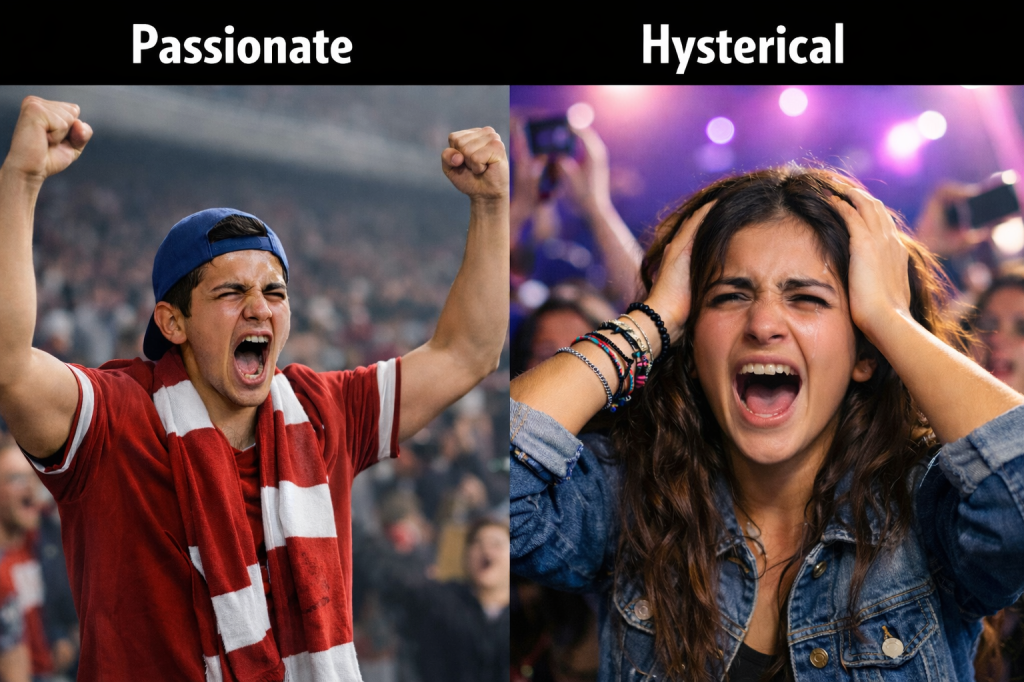
Sometimes sexism is loud and obvious; other times, it is subtle, woven into everyday reactions and social expectations.
Double standards are one of the quietest — and most powerful — ways inequality is upheld.
They shape how we interpret behaviour long before we consciously recognise the bias.
Passion vs. Hysteria — The Emotional Double Standard
Picture this:
A teenage boy cries at a sporting match. The commentary is glowing:
- “Look at his passion.”
- “He cares so much.”
- “What a dedicated young man.”
Now picture a teenage girl crying at a concert:
- “Overdramatic.”
- “Embarrassing.”
- “Typical hysterical girls.”
Same emotional expression.
Opposite judgement.
This is not accidental — it comes from a long cultural history of treating male emotions as powerful and meaningful, while framing female emotions as excessive, irrational, or inconvenient.
In the Workplace: Assertive Men, Difficult Women
The professional world reinforces the same pattern every day.
When a man leads firmly:
- “Strong.”
- “Confident.”
- “A natural leader.”
When a woman leads firmly:
- “Bossy.”
- “Aggressive.”
- “Emotional.”
- “Hard to work with.”
When a man negotiates salary: He’s “strategic” and “ambitious.”
When a woman negotiates salary: She’s “demanding” or “difficult.”
When a man raises concerns or frustration: He’s “driven” and “passionate.”
When a woman raises concerns or frustration: She’s “unstable,” “hormonal,” or “over the top.”
The behaviours are identical.
The interpretations are not.
In Relationships: Leadership vs. Nagging
Even at home, the double standard persists.
When a man sets boundaries or expectations:
- He’s “being reasonable.”
- He’s “standing his ground.”
When a woman sets boundaries or expectations:
- She’s “nagging.”
- She’s “controlling.”
- She’s “overreacting.”
A man who voices his needs is “communicating.”
A woman who voices her needs is “needy.”
In Parenting: Devoted Dad vs. Expected Motherhood
When a father spends time with his children:
- “He’s such a great dad.”
- “So hands-on!”
- “Amazing he’s involved!”
When a mother does the same:
- “That’s just what mothers do.”
And when a father takes his kids alone to the park or grocery store:
- He is celebrated.
When a mother does the same:
- It is invisible.
Men receive praise for basic caregiving.
Women are expected to perform it without recognition, compensation, or complaint.
In Social Life: Confident Men, Attention-Seeking Women
When a man shows pride in his appearance:
- “Good confidence.”
- “He looks sharp.”
When a woman does the same:
- “She wants attention.”
- “She’s full of herself.”
- “She’s trying too hard.”
When a man goes out with friends:
- “He deserves a break.”
When a woman goes out with friends:
- “Where are her kids?”
- “Who is looking after the house?”
- “Must be nice to have all that free time.”
Same behaviour — vastly different social judgement.
The Cost of These Double Standards
Girls learn early that their emotions are judged more harshly.
Women learn that leadership comes with a penalty.
Men learn that their feelings and missteps are more socially validated.
These patterns are not merely unfair — they alter the trajectory of lives.
Women shrink to avoid being labelled.
Men expand into the space society leaves for them.
Why Men Become Uncomfortable When This Is Raised
When we point out these inconsistencies, many men feel attacked, embarrassed, or defensive.
Not because the issues are exaggerated.
But because acknowledging them exposes a system that has quietly benefited them their entire lives.
It is uncomfortable to recognise privilege you didn’t know you had.
This discomfort is not the problem — avoiding the conversation is.
Women Aren’t Immune to These Beliefs — Patriarchy Conditions All of Us
It’s important to recognise that men are not the only ones who reinforce these double standards.
Women also absorb and repeat them, often without realising they are participating in their own limitation.
This isn’t a flaw in women — it is the result of lifelong cultural conditioning.
From childhood, girls are taught:
- to be “nice,”
- to be accommodating,
- to stay quiet to keep the peace,
- to avoid being seen as “too much.”
At the same time, they hear women described as:
- dramatic,
- needy,
- bossy,
- emotional,
- overreacting.
Over years, this messaging becomes internalised.
So when a woman sees another woman assert herself, express emotion, or take authority, she may instinctively judge her through the lens she’s been taught.
Not because she is unkind — but because patriarchy trains women to police each other.
Women learn to shrink themselves.
And sometimes, they unconsciously reinforce the very narratives that limit them:
- labelling other women “dramatic,”
- calling them “bossy,”
- criticising their ambition,
- dismissing their boundaries.
Patriarchy doesn’t just shape men — it shapes women too.
Recognising this isn’t about blaming women; it’s about understanding how deeply these scripts run — and how powerful we become when we see them clearly and choose differently.
Seeing the Pattern Is the First Step to Breaking It
Naming double standards makes them visible.
Once visible, they can be challenged — in schools, workplaces, relationships, media, and within ourselves.
Women deserve the freedom to lead, express emotion, and take up space without penalty.
Men deserve the freedom to feel deeply without being shamed.
And society deserves the honesty to recognise the structures that shape our perceptions.
The goal is not to shame men.
The goal is to expose a cultural script that limits all of us.
 Infemism
Leave a comment